
Pub builds that survive chaos
Bracket builds should survive incomplete vision, random fights, and supports who never buy detection. Copying pro VODs is optional. Surviving pubs is not.
Stop copying DreamLeague item builds in pubs
Professional item builds assume coordinated smoke timing, supports who buy detection without being asked twice, and a team that actually groups up when the draft calls for it. Your ranked pub has none of those guarantees, and yet every patch a wave of players copies the exact build order from a tournament VOD and wonders why it falls apart by minute twenty. Bracket builds need to survive incomplete vision, random uncoordinated fights, and a support who spends their early gold on a Courier upgrade instead of an Observer, because that is the actual game you are playing.
Use OpenDota and Dotabuff to spot general trends in item timing and popularity, then simplify aggressively for your own bracket. If a build requires three teammates to execute a coordinated play in order to pay off, it is not a pub build, it is a highlight reel build that happens to occasionally work when the stars align.
The core insight worth internalizing is that professional teams build around removing variance, since they have already controlled for the variance that pubs cannot remove. A pro support does not need to overbuy detection because the team communicates rotations perfectly. Your pub support absolutely does need to overbuy detection, because nobody is calling rotations and the enemy support is walking around your jungle uncontested.
Core rules for chaos pubs
A short list of rules survives more pub games than any specific item sequence, because these rules adapt to whatever chaos your particular game throws at you rather than assuming a fixed scenario. Memorize the list, apply it every game, and adjust the specific items to your hero and role while keeping the underlying logic constant.
- Buy survival before damage the moment your deaths start turning into a feeding streak rather than isolated mistakes.
- Buy detection yourself if it becomes clear nobody else on your team is going to.
- Buy mobility if the enemy has strong catch potential and your team has none to answer it.
- Skip luxury items entirely until your objectives are actually realistic given the current gold and level gap.
- Change your plan the moment the draft counters your original idea, rather than stubbornly finishing a build that no longer fits the game.
These rules matter most precisely when a game feels like it is spiraling, since that is exactly when players default to their comfort build instead of adapting. A carry who keeps building pure damage into a lineup with three disables and zero counterplay from their own team is following a plan that stopped being correct several deaths ago.
Carry build notes for real pubs
Early armor or basic sustain items beat greedy damage rushing if you have already died twice before the ten minute mark, because a dead carry contributes zero value to the game regardless of what their eventual item build would have looked like. The math on early survival items is simple: staying alive to farm is worth more than the marginal damage increase from rushing a core item one or two minutes faster.
Mid game, honestly assess whether Black King Bar or a pure damage item finishes games faster in your specific bracket, since this answer genuinely varies by skill level. Lower brackets often have less reliable disable chaining, making raw damage slightly more valuable relatively speaking, while higher brackets punish a lack of spell immunity far more severely in every teamfight.
Late game, resist the pull toward a sixth pure damage item if your team still has zero detection and the enemy is clearly running invisibility or stacking wards uncontested. A carry with maximum damage output who dies to an invisible hero because nobody on the team can see them contributes nothing in the fight that actually decides the game.
Mid build notes for real pubs
Level timing matters more than luxury items for most mid heroes in pub games, since the level advantage from efficient farming and correct rune usage compounds faster than most item purchases in the laning stage. A mid player obsessing over their next big item purchase while missing easy experience from a poorly managed wave is optimizing the wrong variable.
If you lose your lane, pivot toward utility items that help the broader map rather than doubling down on another nuking item you cannot cast safely from a position of weakness. A losing mid who buys a second high-cost damage item often just dies slightly slower to ganks than one who bought no items at all, while a losing mid who buys mobility or utility can still contribute meaningfully to the rest of the map.
Offlane build notes for real pubs
Aura items and initiation tools win considerably more pub games than flashy individual carry-style items on an offlaner, because the offlane role in pubs is fundamentally about creating space and enabling uneven fights rather than out-farming the enemy carry directly. An offlaner who tries to build like a secondary carry usually ends up competing for resources with their own team's actual carry, which helps nobody.
Your specific job as an offlaner is manufacturing fights that are not even, either through disables that isolate a single enemy hero or auras that swing a group fight in your team's favor before damage numbers even get compared. Building purely for personal damage output usually fails this job description even when the individual item choices look reasonable in isolation.
Support build notes for real pubs
Force Staff, Glimmer Cape, and detection items are not optional luxuries for a support role, regardless of how tight gold feels in a specific game. These items are the actual difference between successfully saving a core's life during a gank and watching that core die while typing an argument in chat about how the support never buys anything useful.
Support gold in pubs is chronically under-spent on defensive utility because supports often feel pressure to contribute kills or damage numbers that show up on the scoreboard. Resist that pressure. A support who buys the correct defensive items and uses them well contributes far more to the win condition than a support chasing personal kill count with an aggressive item build that leaves the team without any saves in a crucial fight.
Detection economy: who buys what and when
Detection spending in pubs should not fall entirely on one designated support, because relying on a single player means the whole team's detection coverage disappears the moment that player dies or forgets to restock. A functional detection economy spreads Sentry purchases across both support slots and occasionally onto a core who has spare gold and understands the value of not dying to something invisible.
The general rule that works across most brackets: whenever your team's detection coverage drops to zero, whoever notices first should buy a Sentry immediately rather than waiting for the "designated" detection buyer to handle it. Games are lost in the gap between noticing a problem and someone actually fixing it, and detection is one of the cheapest problems to fix immediately once noticed.
- Restock Sentries every trip back to base once objectives like Roshan become relevant.
- Buy detection proactively before a push or Roshan attempt, not reactively after getting caught by an invisible hero.
- Any player, not just supports, should buy a Sentry if the team's detection has clearly run out.
When to break your build mid-game
A build plan made during draft is a hypothesis, not a contract, and treating it as a fixed contract regardless of how the game actually unfolds is one of the most common ways pub players sabotage their own games. If the enemy draft reveals a specific threat your original plan does not address, such as heavy magic damage burst or a strong invisibility hero, adjust your item sequence immediately rather than finishing the original plan out of stubbornness.
The signal to break a build is usually obvious in hindsight but easy to miss in the moment: repeated deaths to the same specific threat, a team fight loss pattern that traces back to the same missing item category, or an enemy power spike your current build simply does not answer. Recognizing these signals during the game, rather than only in the post-game analysis, is what separates players who adapt from players who lose the same way three games in a row.
Builds that respect vision and cooldowns
Itemization without information is gambling dressed up as strategy. Read our ward vision guide and cooldown tracking guide before blaming a lost fight purely on the build, because a technically correct item purchase still fails constantly if you walk into a fight blind against fully available enemy ultimates. The best itemization in the world does not compensate for zero information about what the enemy team can currently do to you.
This connection works in both directions. Vision and cooldown tracking tell you what threats exist and when they are available, which directly informs which defensive or offensive items actually matter in your specific game. A build decision made with full information about enemy cooldowns and vision coverage is simply a better decision than the same build decision made blind, even if the item list itself looks identical on paper.
Using inventory awareness tools
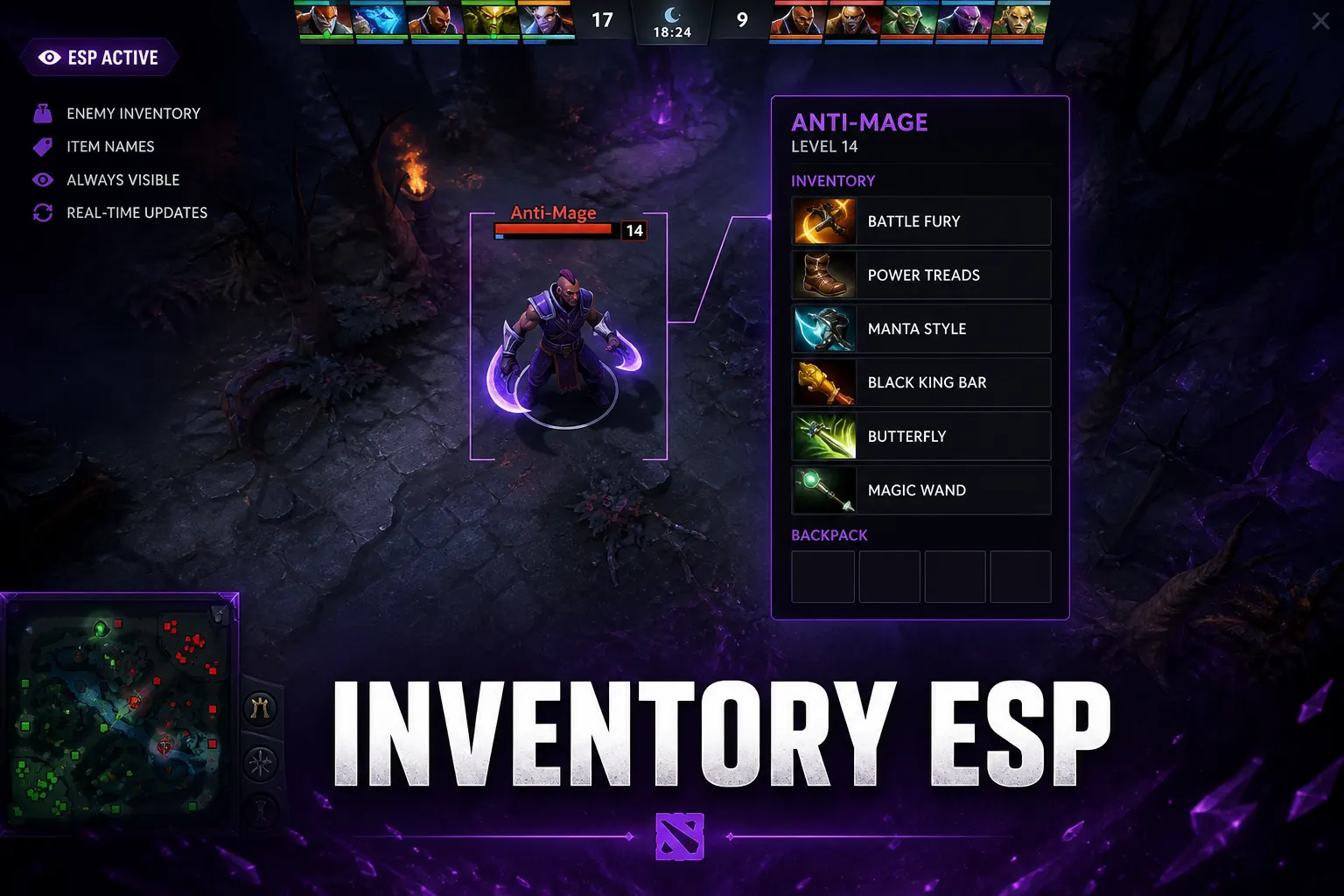
Hero ESP and inventory overlay tools help answer a specific, high-value question during a fight: has the enemy finished Black King Bar yet, or do they still only have a Force Staff and a partial item build. That single piece of information changes whether your team commits to a fight immediately or waits for a better window, and getting it wrong in either direction costs games. Browse Hero ESP details and the features page for a full breakdown of what inventory tracking actually shows during a live match.
If you want to see how this looks in practice before deciding whether it fits your own routine, the demo page has footage showing inventory tracking during real fights. Questions about licenses, setup, and general compatibility are answered on our FAQs page.
Patch-agnostic principles that always hold
Specific items rotate in and out of relevance every patch, but a handful of underlying principles survive every single balance change regardless of what got buffed or nerfed. Survival items scale in value with how often your deaths are actually costing your team the game, not with a fixed formula from a guide written months before the current patch. Detection value scales with how much invisibility and vision denial the current meta favors, which shifts patch to patch but the underlying logic of "buy detection when you cannot see threats" never changes.
Mobility value scales with how much catch potential the enemy draft has relative to your own team's escape tools, a comparison that has to be made fresh every single draft rather than assumed from a general guide. Treat every specific item recommendation you read anywhere, including on this site, as a temporary conclusion from a permanent principle, and you will adapt correctly even when the exact meta shifts underneath you.
Common build mistakes by MMR bracket
Herald and Guardian games typically see builds that ignore survival entirely in favor of maximum damage output, since lower bracket players often equate a bigger damage number with a better build regardless of how many times that hero is dying before reaching a relevant item count. The fix is straightforward: build enough survival to actually reach your damage items in a playable state.
Crusader and Archon builds start incorporating some situational awareness but frequently mistime detection purchases, buying Sentries reactively after a death rather than proactively before an objective attempt. Legend and Ancient brackets generally understand itemization logic well but struggle with the discipline of breaking a build plan mid-game when the draft or the game state clearly calls for it.
Divine and Immortal pubs usually have strong individual itemization but weaker team-wide detection economy, similar to the vision economy issue at the same bracket level, since individual players optimize their own build correctly without necessarily coordinating who covers what for the team as a whole.
Neutral items and pub build flexibility
Neutral items add a layer of build flexibility that pub players routinely under-optimize, either by equipping whatever dropped most recently regardless of fit or by ignoring the neutral item slot entirely until someone in chat points it out. Treat neutral item choice with the same situational logic as the rest of your build: a defensive neutral item matters more when your deaths are mounting, and an offensive or utility neutral item matters more when your team is already ahead and looking to close out the game.
Stash management for neutral items matters more than most players realize, since holding onto a strong item in your stash instead of equipping it because "I might need the slot for something better later" often means never actually benefiting from an item that was sitting there the whole game. If a neutral item solves a problem you currently have, use it, rather than saving a hypothetical future upgrade that may never drop before the game ends.
Buyback economy and pub builds
Buyback gold is effectively a build decision that most pub players never think about explicitly, spending down to near-zero gold on items without considering that a dead hero with no Buyback available is a five-versus-four fight waiting to happen at the worst possible moment. Once a game reaches the point where Roshan and high ground objectives are actively being contested, factor Buyback availability into every item purchase, since an extra damage item is worthless if it comes at the cost of your team's ability to respond to a bad fight.
The specific mistake to watch for is spending your absolute last gold on a marginal item upgrade right before a contested teamfight or Roshan attempt, leaving zero Buyback available if that fight goes badly. A slightly weaker item with Buyback gold in reserve is almost always the better trade once objectives are actively in play, even though the marginal item upgrade feels more exciting to purchase in the moment.
Adapting builds against invisibility-heavy lineups
A draft with one or more strong invisibility tools demands a build adjustment that goes beyond just "buy a Sentry," since the entire team's positioning and risk tolerance needs to shift when the enemy can approach from directions your vision cannot cover by default. Detection items should be distributed across multiple players rather than concentrated on one designated buyer, since an invisibility-heavy enemy team specifically benefits from picking off the one player carrying detection before engaging the rest of your team.
Beyond items, adjust your actual positioning habits against invisibility threats: group slightly tighter than you normally would, avoid isolating a single core away from the group even when farm efficiency suggests splitting up, and treat any unexplained silence from the enemy team as a potential invisible approach rather than a farming lull.
Adapting builds against illusion and summon-heavy lineups
Illusion and summon-heavy enemy drafts punish builds that rely purely on single-target damage or single-target disables, since a fight against a wave of illusions or summoned units requires area damage and area control to actually resolve efficiently. If you notice the enemy draft leaning heavily into this style during the pick phase, prioritize area damage items and abilities over single-target burst, even if your hero's kit naturally favors single-target play.
Detection also matters against illusion-heavy lineups in a less obvious way than against invisibility, since some illusion effects create genuine confusion about which unit is the real hero in a chaotic fight. Items or abilities that reveal true sight or pierce illusion effects become considerably more valuable in these specific matchups than their general reputation across all games would suggest.
Itemization for common pub team shapes
A surprising number of pub games fall into recognizable team shapes that are worth planning around explicitly rather than pretending every game is a balanced five-role draft executing a textbook strategy. The "four protect one" shape, where four heroes farm minimally and funnel resources into a single carry, shows up constantly in solo queue even without any coordination, simply because four players get discouraged early and stop contesting farm. If you recognize this shape forming, whether you are the carry benefiting from it or one of the four not benefiting, adjust your build to match the reality: the designated carry should prioritize core farming items aggressively, while the other four should lean hard into survival and utility since they are not going to out-farm anyone this game anyway.
The "no support" shape, where both support slots get filled by players who farm like cores and never rotate to help lanes, is another recognizable pub pattern that punishes standard build assumptions. If you find yourself in a game with this shape, whichever core is most flexible needs to absorb some support responsibilities including detection purchases, even if that means delaying their own item timings, because the alternative is a team with zero vision and zero rotations for the entire game.
The "everyone farms jungle" shape, common in lower brackets, leaves lanes undefended while multiple players individually decide the jungle is safer than contesting a lane. Builds in this shape should lean toward whatever lets you survive being the only lane presence for extended stretches, since towers will fall regardless of your item choices if nobody contests the lane at all, and your personal survival items matter more than your damage output in a game shape that is already going poorly at a structural level.
Rebuilding after a bad start
Pub games with a rough laning stage put pressure on the original build plan in a way that punishes players who refuse to acknowledge the game has changed. A carry who lost their lane badly and is now several levels and several hundred gold behind schedule needs a genuinely different item path than the one drafted with an even laning stage in mind, prioritizing catch-up mechanisms like cheaper survival items and farming tools over the luxury items originally planned before the game went sideways.
The mental shift required here is treating the original build as one branch of a decision tree rather than the only acceptable outcome. A player who mentally locked in a specific six-item build during the loading screen and refuses to deviate from it regardless of how the laning stage actually goes is optimizing for a game that stopped existing the moment the lane was lost. Flexibility at this stage, even if it means a less exciting or less popular item path, consistently outperforms stubborn adherence to a pre-game plan that current circumstances have already invalidated.
Putting the whole build philosophy together
A pub-ready build philosophy is not a fixed item list, it is a decision framework: survival before greed when deaths are mounting, detection as a shared team responsibility rather than one player's job, willingness to break a plan the moment the game reveals it was wrong, and constant reference to the vision and cooldown information from ward vision and cooldown tracking. Apply that framework consistently and your builds will survive far more of the chaos that actually defines a ranked pub, regardless of what the current patch's tier list happens to say.